
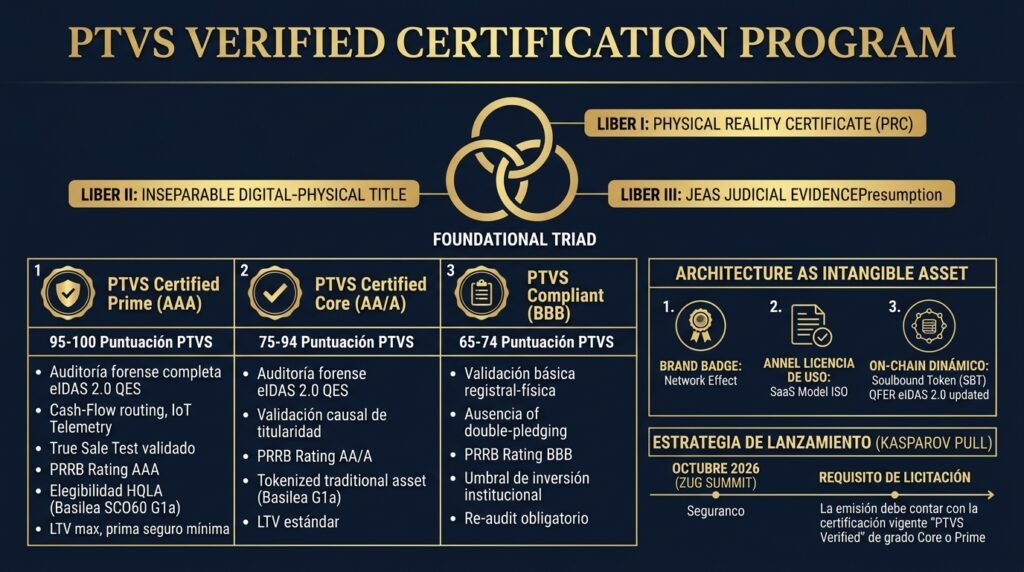
Zug, Switzerland — As global banking regulators finalize the prudential treatment of crypto-asset exposures, financial institutions face a critical bottleneck: the inability to prove the continuous physical integrity of tokenized Real-World Assets (RWAs). Under the BCBS framework, tokens lacking verifiable, continuous backing are classified as Group 2 crypto-assets, subject to a 1250% risk weight—a capital requirement that effectively prohibits institutional custody.
The Corpus Legislativum PTVS v1.0 resolves this regulatory impasse. By integrating ISO/IEC 17020 forensic inspections, satellite telemetry (GEE-PTVS), and the RFC-003 ‘Hollow Token’ circuit breaker, PTVS provides the deterministic, on-chain evidence required by auditors and the Basel Committee to classify tokenized RWAs as Group 1a/1b Tokenized Traditional Assets, subject to standard risk-weighted asset (RWA) calculations.
I. The BCBS Bottleneck: The “Physical Oracle Gap” in Capital Requirements
The BCBS prudential framework distinguishes between crypto-assets based on their stabilization mechanisms and redemption rights. For a tokenized real estate asset or a tokenized commodity to qualify for standard capital treatment (Group 1), the issuing bank must prove that the token represents a direct, enforceable claim on the underlying physical asset, and that the asset is continuously safeguarded.
Traditional annual PDF appraisals fail this test. They are static, easily altered, and cannot detect real-time physical degradation, unauthorized liens, or structural failure. This creates the Physical Oracle Gap: the blockchain ledger claims the asset is worth €50M, but the physical reality may have diverged drastically, exposing the bank to severe liquidity and solvency risks under Basel III (SCO60).
II. PTVS v1.0: The Cryptographic Bridge to Group 1 Classification
PTVS v1.0 provides the missing evidentiary layer. The framework generates a Qualified Forensic Evidence Record (QFER) for every tokenized asset. The QFER is not merely a report; it is a cryptographically sealed, legally binding instrument that satisfies the BCBS requirements for continuous safeguarding:
Immutable Provenance (SHA-256 + EBSI)
The QFER hash is anchored to the European Blockchain Services Infrastructure (EBSI). Auditors can instantly verify that the physical state of the asset has not been retroactively altered, satisfying the “safekeeping” requirement of MiCA Art. 36 and Basel III.
ISO/IEC 17020 Independent Verification
QFERs are issued exclusively by PropTrust Certified Experts (PTCE) operating under strict Type A independence requirements. This provides the objective, third-party validation required by bank internal audit committees.
III. The ‘Hollow Token’ Protocol (RFC-003) and Continuous HQLA Validation
The most critical innovation of PTVS v1.0 for banking compliance is the RFC-003 ‘Hollow Token’ protocol. Under Basel III, an asset can only be classified as High-Quality Liquid Asset (HQLA) if it can be easily and immediately converted into cash at little or no loss of value.
If GEE-PTVS satellite telemetry or a PTCE inspection detects a critical physical anomaly (e.g., severe structural subsidence, environmental contamination, or a court-ordered demolition), the RFC-003 protocol automatically triggers a circuit breaker in the ERC-3643 smart contract. The token is instantly frozen, preventing secondary market trading and alerting the custodian bank’s risk committee.
This automated, deterministic response proves to regulators that the bank has continuous, real-time control over the physical risk of the collateral, a prerequisite for maintaining HQLA status and favorable risk-weighted asset calculations.
“Banks do not fear blockchain; they fear unverified physical risk. PTVS v1.0 transforms the ‘Physical Oracle Gap’ from a regulatory liability into a cryptographic asset. By proving continuous physical integrity, we unlock the door for institutional capital to flow into tokenized markets without the burden of punitive capital charges.
ATAurelio Tamarit BlayLead Architect, PTVS v1.0 · Official Judicial Expert Col. No. 0161Managing Member, Aurema Group LLC (Delaware)
IV. Strategic Implications for Custodian Banks and Family Offices
The adoption of the PTVS v1.0 framework offers immediate strategic advantages for Tier-1 financial institutions:
- Capital Efficiency: Reclassifying tokenized RWAs from Group 2 (1250% risk weight) to Group 1 (standard risk weight) drastically reduces the capital reserves banks must hold, freeing up billions in liquidity.
- Audit Trail Automation: The QFER provides a continuous, cryptographically verifiable audit trail, reducing the time and cost of internal and external regulatory audits.
- First-Mover Advantage: Banks that integrate PTVS-compliant custody solutions will be uniquely positioned to capture the projected $30 trillion institutional RWA market, offering superior yield and security to Family Offices and sovereign wealth funds.