
Zug, Switzerland — The final pillar of the Corpus Legislativum PTVS v1.0 addresses the geopolitical reality of digital infrastructure. In an era of data localization laws, extraterritorial jurisdictional claims (such as the US CLOUD Act), and fragmented national blockchain regulations, a truly global standard for Real-World Asset (RWA) tokenization requires a jurisdiction of absolute neutrality and a legal framework of supranational reach.
PropTrust Association, domiciled in Zug, Switzerland, provides this neutral anchor. By integrating the Rome I Regulation (EC) No 593/2008, the Rome II Regulation (EC) No 864/2007, and the UNIDROIT Principles (2016), PTVS v1.0 operates as a supranational legal layer that ensures Digital Sovereignty for European and global institutional participants.
I. Swiss Neutrality as the Bedrock of Digital Trust
Switzerland’s permanent neutrality, recognized internationally since the Congress of Vienna (1815), makes it the ideal domicile for the governance of a supranational standard like PTVS v1.0. Unlike jurisdictions subject to aggressive extraterritorial data requests or shifting political regimes, Swiss law provides a stable, predictable, and impartial legal environment.
By housing the PropTrust Association in Zug and anchoring the cryptographic hashes of the Qualified Forensic Evidence Records (QFER) to the European Blockchain Services Infrastructure (EBSI), the framework ensures that the evidentiary truth of European RWAs remains under European digital sovereignty, protected by Swiss legal neutrality.
II. Rome I Regulation: Governing Smart Contract Obligations
The Rome I Regulation (EC) No 593/2008 determines the law applicable to contractual obligations within the EU. In the context of RWA tokenization, the smart contract governing the token represents the contractual agreement between the issuer and the holder.
PTVS v1.0 utilizes the principle of party autonomy (Article 3) to allow institutional parties to choose the supranational rules of the Corpus Legislativum as the governing framework for the forensic verification layer of their contract. Furthermore, in the absence of choice, Article 4 provides clear fallback rules. The QFER serves as the objective, jurisdiction-agnostic evidence of the asset’s physical state, satisfying the contractual warranties regardless of the chosen national law.
III. Rome II Regulation: Objective Fault and Cross-Border Torts
When physical assets suffer damage, or when fraudulent misrepresentation occurs regarding an RWA’s condition, the dispute shifts from contract to tort (non-contractual obligation). The Rome II Regulation (EC) No 864/2007 governs these conflicts.
Under Article 4, the law of the country where the damage occurs applies. However, proving fault and causation across borders is notoriously difficult. The PTVS framework resolves this by providing the QFER: a cryptographically sealed, time-stamped record of the asset’s exact physical and legal condition. This eliminates the “he-said, she-said” ambiguity of cross-border torts, providing courts and arbitrators with an indisputable baseline of fact that satisfies the evidentiary requirements of any EU Member State.
IV. UNIDROIT Principles and the Modern Lex Mercatoria
The UNIDROIT Principles of International Commercial Contracts (2016) represent the most authoritative restatement of general contract law principles globally. They are frequently used to interpret or supplement international uniform law instruments, and serve as a model for national and international legislators.
The Corpus Legislativum PTVS v1.0 is deeply aligned with core UNIDROIT principles:
- Freedom of Contract (Article 1.1): Parties are free to enter into a contract and determine its content. The integration of PTVS into a smart contract is a voluntary exercise of this freedom.
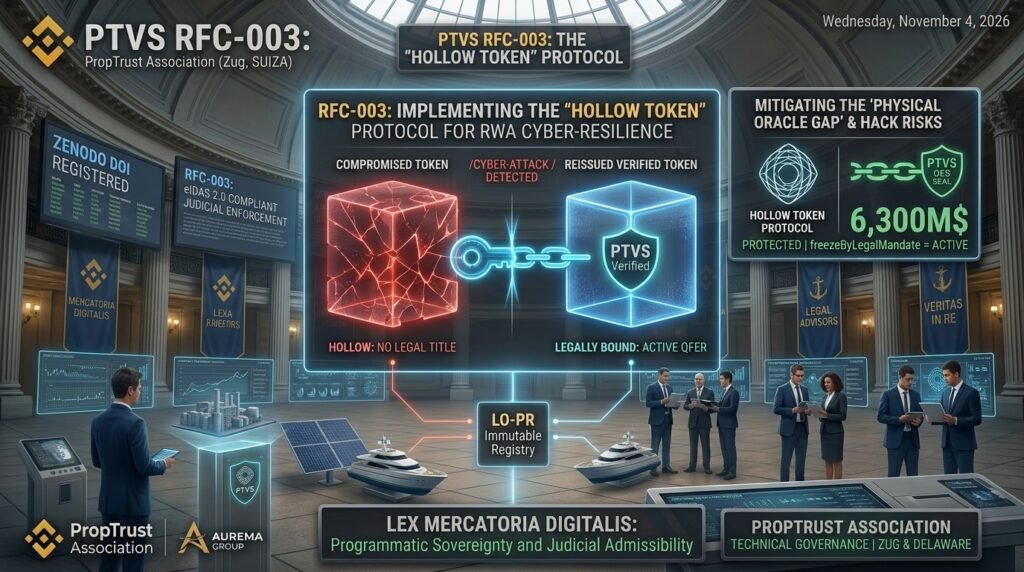
- Good Faith and Fair Dealing (Article 1.7): As enforced by the RFC-003 ‘Hollow Token’ circuit breaker, ensuring that digital representations never diverge from physical reality.
- Pacta Sunt Servanda (Article 1.3): Contracts must be observed. The cryptographic immutability of the QFER ensures that the foundational facts of the contract cannot be retroactively altered.
“True digital sovereignty is not achieved by building higher firewalls, but by establishing legal frameworks so robust, so neutral, and so universally recognized that they transcend the need for borders. With the Corpus Legislativum PTVS v1.0, anchored in Swiss neutrality and European digital infrastructure, we have built the bridge to that future.
ATAurelio Tamarit BlayLead Architect, PTVS v1.0 · Official Judicial Expert Col. No. 0161Managing Member, Aurema Group LLC (Delaware)Proclaimer, Corpus Legislativum PTVS v1.0
V. The 2027 Strategic Roadmap: From Proclamation to Global Adoption
With the publication of this final article, the Corpus Legislativum PTVS v1.0 is fully proclaimed. The roadmap for 2027 and beyond focuses on three strategic pillars:
- Institutional Onboarding: Formal integration of the PTVS standard by Tier-1 European banks, Family Offices, and regulated tokenization platforms seeking MiCA and Basel III compliance.
- Academic and Judicial Recognition: Continued submission of the framework to international arbitral tribunals (ICC, ICSID) and academic repositories (CERN Zenodo) to cement its status as customary transnational law.
- Expansion of the PTCE Network: Scaling the global network of PropTrust Certified Experts to ensure that high-quality forensic verification is available in every major jurisdiction.