
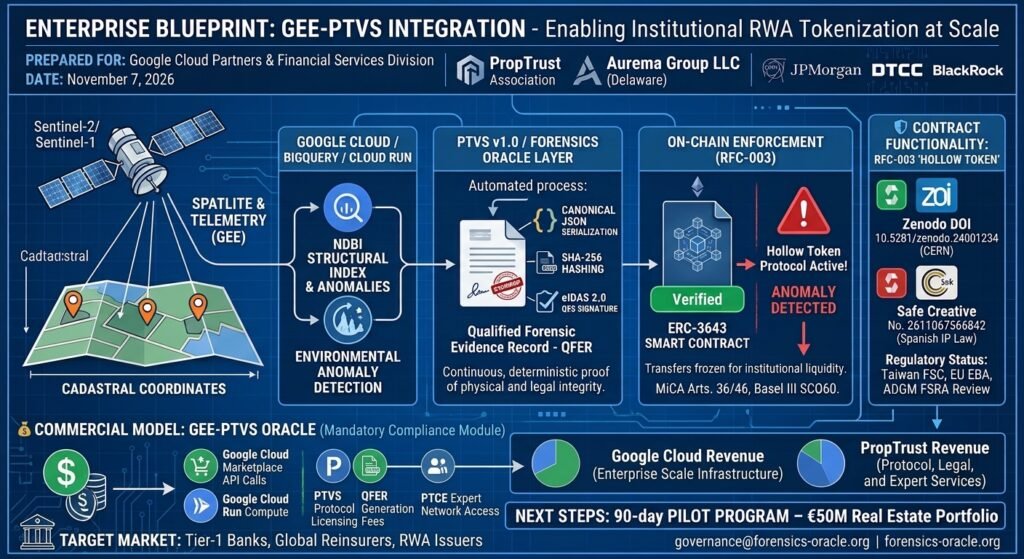
Zug, Switzerland / Brussels, Belgium — As the European Union’s Digital Operational Resilience Act (DORA) enters its full enforcement phase, financial entities and crypto-asset service providers (CASPs) face unprecedented scrutiny regarding their ICT third-party risk management and operational continuity. Today, the PropTrust Association confirms that the Prop Trust Verified Standard (PTVS) v1.0 is natively architected to satisfy these rigorous mandates.
By integrating Confidential Computing, decentralized identity verification, and automated incident response protocols, PTVS v1.0 provides a cyber-resilient foundation for the tokenization of Real-World Assets (RWA), eliminating the operational friction that has historically hindered institutional adoption.
01. ICT Risk Management & Confidential Computing
DORA Article 10 mandates robust ICT risk management frameworks. PTVS v1.0 addresses this by processing all sensitive forensic telemetry and QFER (Qualified Forensic Evidence Record) generation within Trusted Execution Environments (TEEs).
AMD SEV-SNP Enclaves
Forensic data is processed in hardware-isolated memory enclaves, ensuring that neither the cloud provider nor malicious actors can access raw asset telemetry during computation.
Zero-Trust Cryptography
All QFER hashes are generated using SHA-256 and signed with eIDAS 2.0 Qualified Electronic Signatures (QES) within the secure enclave, guaranteeing data integrity before it ever touches the blockchain.
02. Automated Incident Reporting & Circuit Breakers
Under DORA Article 17, financial entities must classify and report major ICT-related incidents. PTVS v1.0 automates this compliance through its RFC-003 ‘Hollow Token’ protocol.
- Anomaly Detection: If GEE-PTVS satellite telemetry or a PTCE inspection detects a critical physical or legal anomaly (e.g., structural failure, unauthorized lien), the system instantly flags a major incident.
- Automated Circuit Breaker: The ERC-3643 smart contract automatically freezes secondary market transfers of the affected RWA token, preventing the propagation of toxic assets.
- Regulatory Notification: The incident is cryptographically logged and instantly reported to the relevant compliance officers and regulatory nodes via the EBSI Trusted Register, satisfying DORA’s strict reporting timelines.
“Cyber-resilience is not an add-on; it is the bedrock of digital trust. By aligning PTVS v1.0 with DORA, NIS2, and the CRA, we are providing European financial institutions with a turnkey solution that satisfies their most stringent operational resilience requirements while unlocking the liquidity of Real-World Assets.
ATAurelio Tamarit BlayLead Architect, PTVS v1.0 · Official Judicial Expert Col. No. 0161Managing Member, Aurema Group LLC (Delaware)
03. Third-Party Risk & PTCE Certification
DORA places heavy emphasis on managing ICT third-party risk. The PropTrust Certified Expert (PTCE) network operates as a decentralized, highly vetted layer of human oracles.
Every PTCE is accredited under strict ISO/IEC 17020 conformity assessment standards and their credentials are issued as W3C Verifiable Credentials (VCs) anchored to the EBSI. This allows financial entities to instantly and cryptographically verify the standing, insurance, and competency of any expert interacting with their RWA infrastructure, completely eliminating the opacity of traditional third-party vendor risk.