
Independent non-profit Swiss Association (Zug, Switzerland) governing the global standard for physical integrity, forensic auditing, and physical yield gating in RWA tokenization
Independent non-profit Swiss Association (Zug, Switzerland) governing the global standard for physical integrity, forensic auditing, and physical yield gating in RWA tokenization
November 11, 2026 | Zug, Switzerland / Valencia, Spain
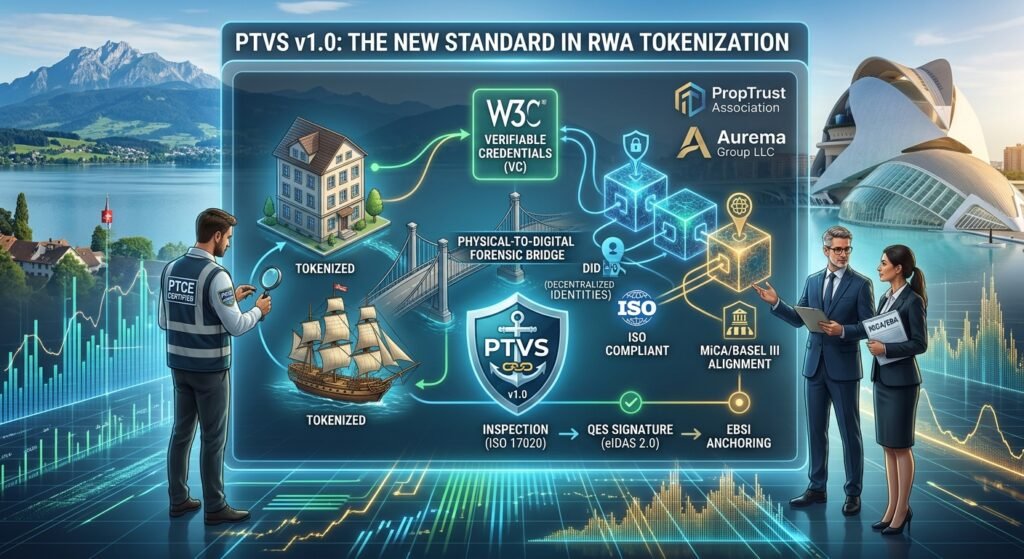
Zug, Switzerland / Valencia, Spain — The PropTrust Association and Aurema Group LLC have announced a strategic milestone in the governance architecture of Real-World Asset (RWA) tokenization: the formal alignment of the Prop Trust Verified Standard (PTVS) v1.0 with open standards from the W3C (World Wide Web Consortium) and ISO normalization guidelines.
This strategic positioning generates what industry analysts term a regulatory “Pull Effect.” Driven by mounting pressure from supervisory authorities such as the Spanish National Securities Market Commission (CNMV) and the European Banking Authority (EBA) for structural transparency in crypto-asset markets, a standard natively compatible with established international frameworks naturally becomes the default reference model adopted in future policy circulars.
To ensure that technical quality control remains in the hands of accredited professionals, the PropTrust Association maintains exclusive authority over the PTCE (PropTrust Certified Expert) designation.
As part of this roadmap, the organization has initiated the drafting of a foundational technical Position Paper for submission to the W3C Credentials Community Group (CCG). This document outlines a formal framework for a Verifiable Credential (VC) schema built on Decentralized Identifiers (DIDs). The schema enables physical inspection records and forensic expert credentials to be instantly verified on-chain and cross-referenced with sovereign infrastructures like the European Blockchain Services Infrastructure (EBSI).
The adoption of a Layer-0 verification framework based on open standards provides direct advantages across the ecosystem:
The technical Position Paper for the W3C CCG will be formally submitted this month by Aurema Group’s engineering team, opening a period of restricted review for technology partners, financial institutions, and academic coordinators affiliated with the PropTrust ecosystem. The executive summary is available upon request for accredited media and institutional partners.
Aurelio Tamarit Blay
Lead Architect, PTVS v1.0 / Managing Member, Aurema Group LLC
📧 governance@forensics-oracle.org
📞 +34 662 221 582
🌐 forensics-oracle.org | proptrust-association.ch