
Zug, Switzerland — As institutional capital increasingly targets high-value maritime assets, commercial vessels, and offshore energy installations for blockchain tokenization, the industry faces a critical hurdle: movable property registries operate under complex, fragmented international maritime laws (such as flag state jurisdictions and admiralty law).
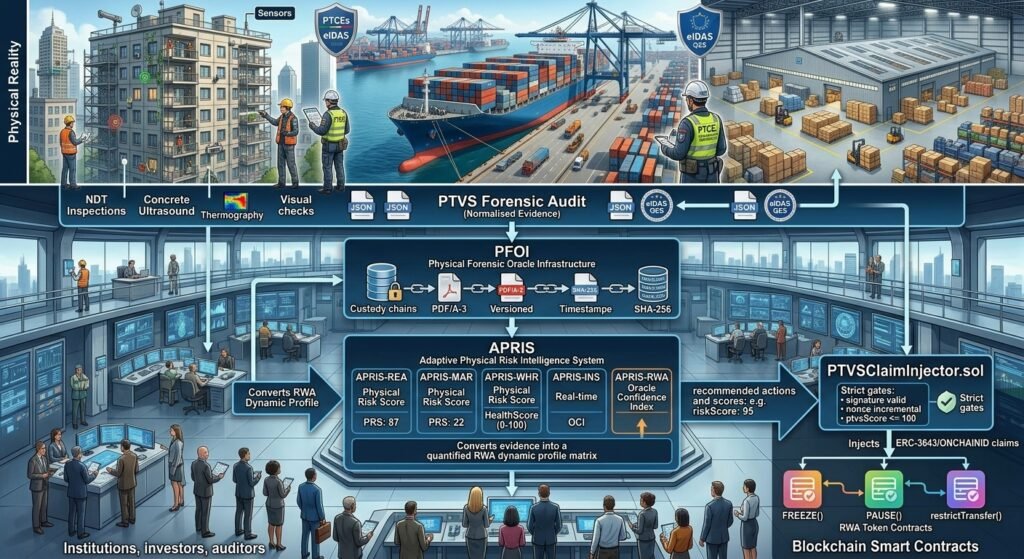
To resolve this exposure, the PropTrust Association has deployed the maritime extension of the Prop Trust Verified Standard (PTVS v1.0). This specialized layer bridges physical naval engineering diagnostics with decentralized smart contracts, ensuring that tokenized shares in commercial vessels or port infrastructures maintain an unshakeable link to their physical and structural reality.
I. The Specificity of Movable and Floating Collateral
Unlike fixed real estate, maritime assets are subject to continuous structural stress, marine corrosion, spatial displacement across international waters, and complex statutory mortgage registrations across different flag states. Standard digital tokens lack the capability to monitor structural integrity or dry-dock maintenance records in real-time.
Under the PTVS v1.0 maritime framework, certified naval forensic experts conduct rigorous hull, machinery, and safety audits. The resulting telemetry and inspection metrics are compiled into a Qualified Forensic Evidence Record (QFER), establishing an immutable baseline of the vessel’s valuation and physical condition.
II. Integration with Smart Contracts and Automated Circuit Breakers
Tokenized maritime assets integrated via PTVS utilize the RFC-003 ‘Hollow Token’ protocol. If a vessel suffers major structural damage, fails mandatory safety inspections, or loses its insurance certification, the oracle layer automatically flags the QFER state change.
This triggers an automated circuit breaker in the underlying ERC-3643 smart contracts, temporarily freezing transferability or notifying institutional investors of collateral impairment before secondary market losses can compound.
“Maritime assets represent the ultimate test of cross-border collateral integrity. By applying rigorous ISO/IEC 17020 naval inspection standards and anchoring them through eIDAS 2.0 electronic signatures, PTVS v1.0 gives maritime investors the absolute certainty that their digital tokens reflect the true, seaworthy reality of the physical fleet.
ATAurelio Tamarit BlayLead Architect, PTVS v1.0 · Official Judicial Expert Col. No. 0161Naval Forensic Engineering & Structural Specialist