
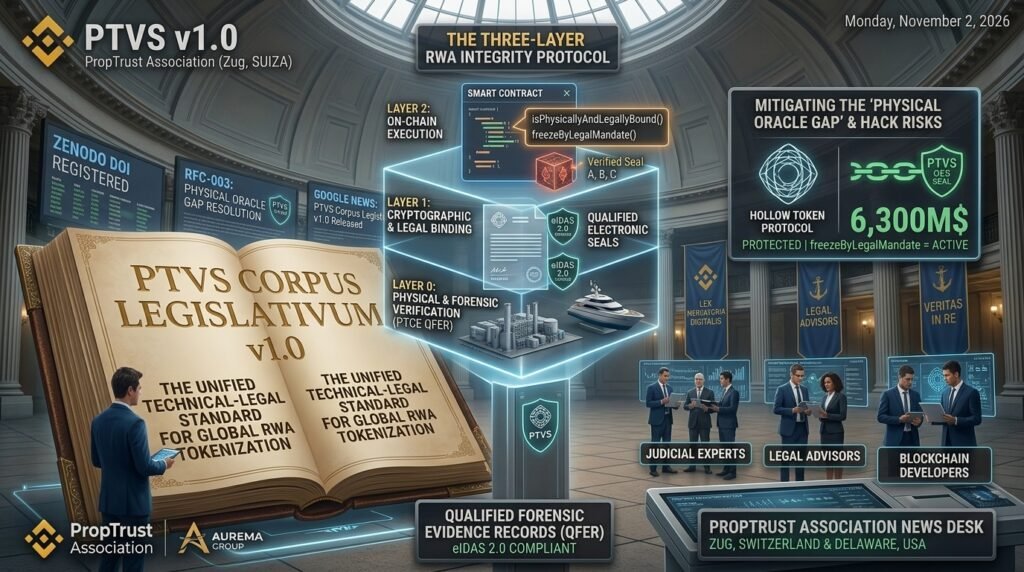
Zug, Switzerland — In international arbitration, the outcome of high-stakes disputes involving Real-World Assets (RWA) frequently hinges on the quality, independence, and admissibility of expert forensic evidence. The Corpus Legislativum PTVS v1.0 establishes the Qualified Forensic Evidence Record (QFER) and the PropTrust Certified Expert (PTCE) as the gold standard for such evidence, explicitly designed to satisfy the rigorous procedural and evidentiary requirements of premier arbitral institutions.
By integrating ISO/IEC 17020 compliance, eIDAS 2.0 Qualified Electronic Signatures (QES), and EBSI cryptographic anchoring, the PTVS framework eliminates the traditional challenges of authenticating expert reports across jurisdictions, streamlining the arbitral process under the ICC, ICSID, and the New York Convention.
I. Admissibility under ICC Rules and IBA Guidelines
The ICC Rules of Arbitration (Article 25) empower the arbitral tribunal to appoint experts and establish the terms of reference for their reports. The IBA Rules on the Taking of Evidence in International Arbitration (Article 5) set forth the standards for Party-Appointed and Tribunal-Appointed Expert Witnesses.
Independence and Impartiality (IBA Art. 5.2)
PTCE experts are bound by strict ISO/IEC 17020 Type A independence requirements. Their credentials, including declarations of independence, are issued as W3C Verifiable Credentials, instantly verifiable by the tribunal.
Authenticity of the Expert Report (IBA Art. 5.2(c))
The QFER satisfies the requirement for a signed statement of the expert’s qualifications and independence. The eIDAS 2.0 QES provides a higher standard of authenticity than a traditional handwritten signature, preventing any challenge to the report’s origin.
II. ICSID and Sovereign RWA Disputes
As states increasingly tokenize infrastructure and natural resource assets, disputes between foreign investors and host states fall under the jurisdiction of the International Centre for Settlement of Investment Disputes (ICSID).
In such disputes, the physical condition and regulatory status of the asset are frequently contested. The PTVS framework provides ICSID tribunals with an objective, technologically neutral evidentiary baseline. Because the QFER is anchored to the European Blockchain Services Infrastructure (EBSI), a sovereign, permissioned ledger, it carries a presumption of integrity that is highly persuasive in investor-state arbitration, where allegations of evidence tampering by state actors are common.
III. The New York Convention (1958) and Enforcement
The ultimate test of arbitral evidence is its role in the enforcement of the resulting award under the New York Convention on the Recognition and Enforcement of Foreign Arbitral Awards (1958). Article V(1)(b) allows refusal of enforcement if a party was “unable to present his case.”
The PTVS framework actively prevents such challenges. By providing all parties with real-time, cryptographically verifiable access to the same QFER data via EBSI, PTVS ensures absolute procedural fairness and transparency. Furthermore, when an arbitral award incorporates a QFER as a foundational exhibit, the cryptographic immutability of that exhibit strengthens the award’s resilience against challenges based on “fraud” or “public policy” (Article V(2)(b)) in national enforcement courts.
“International arbitration thrives on trust, but it is slowed by the verification of that trust. The PTCE and the QFER do not merely participate in the arbitral process; they elevate it. By replacing disputable paper trails with cryptographic certainty, we give arbitral tribunals the most powerful tool for justice: indisputable truth.
ATAurelio Tamarit BlayLead Architect, PTVS v1.0 · Official Judicial Expert Col. No. 0161Managing Member, Aurema Group LLC (Delaware)
IV. The PTCE as the Ideal Arbitral Expert
For arbitral institutions and parties seeking to appoint an expert, the PTCE designation offers unparalleled advantages:
- Pre-Vetted Competence: PTCE certification requires rigorous training in both traditional forensic methodologies (ISO/IEC 17020) and blockchain cryptography (EBSI, SHA-256, eIDAS 2.0).
- Cross-Border Recognition: Backed by the Swiss-domiciled PropTrust Association and aligned with EU eIDAS 2.0, the PTCE credential carries inherent weight in civil and common law jurisdictions alike.
- Efficiency: The standardized QFER format reduces the time and cost associated with challenging the form or authenticity of expert evidence, allowing tribunals to focus on the substantive merits of the dispute.