
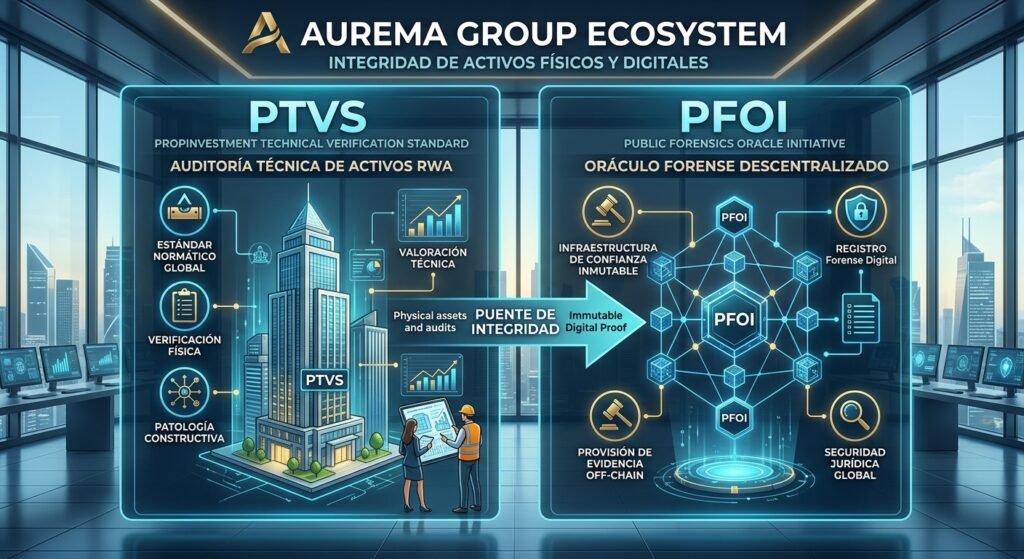
Zug, Switzerland — The maritime industry stands at the precipice of a digital revolution. Ship tokenization, offshore platform fractionalization, and port infrastructure securitization promise to unlock trillions in illiquid maritime assets. However, the sector faces a unique challenge: the Physical Oracle Gap is magnified in the maritime domain, where assets are mobile, jurisdictionally fluid, and subject to complex international lien regimes.
The Corpus Legislativum PTVS v1.0 now addresses these maritime-specific challenges. By integrating specialized naval forensic inspections, Google Earth Engine satellite telemetry (GEE-PTVS) for port monitoring, and cryptographic anchoring to the European Blockchain Services Infrastructure (EBSI), the framework provides the evidentiary certainty required by maritime financiers, lessors, and tokenization platforms.
I. The Cape Town Convention and the Cryptographic International Registry
The Cape Town Convention on International Interests in Mobile Equipment (2001) and its Protocol on Matters Specific to Aircraft Equipment revolutionized aviation finance by creating an international registry for security interests. While the Convention also covers railway rolling stock and space assets, its application to ships and maritime assets remains a critical frontier for institutional investment.
PTVS v1.0 provides the technological infrastructure to operationalize Cape Town principles for tokenized vessels. The Qualified Forensic Evidence Record (QFER) functions as a cryptographic International Registry entry, recording:
- Ownership and Encumbrances: The QFER cryptographically seals the vessel’s title status, existing liens, and maritime mortgages, preventing the “double financing” fraud that plagues the shipping industry.
- Physical Condition: Naval forensic inspections under ISO/IEC 17020 document hull integrity, machinery condition, and class society certifications, providing the due diligence required by maritime lessors and tokenization platforms.
- Port State Control History: GEE-PTVS satellite telemetry tracks vessel movements and port calls, cross-referencing with Paris MoU and Tokyo MoU databases to flag detention histories or safety violations.
II. GEE-PTVS Satellite Telemetry: Port Surveillance and Vessel Tracking
Unlike static real estate, maritime assets are in constant motion. The GEE-PTVS (Google Earth Engine – Prop Trust Verified Standard) integration provides continuous satellite surveillance of tokenized vessels and offshore platforms:
AIS Integration & SAR Imagery
Synthetic Aperture Radar (SAR) satellite imagery from Sentinel-1 detects vessel presence, size, and activity even in adverse weather or when AIS transponders are disabled (“dark vessels”), preventing location spoofing fraud.
Port Infrastructure Monitoring
Multispectral Sentinel-2 imagery monitors port infrastructure tokenization projects, detecting subsidence, structural degradation, or unauthorized construction that could compromise the asset’s value as collateral.
III. Naval Forensic Inspections: The Human Oracle at Sea
Satellite telemetry cannot replace the expertise of a seasoned naval architect or marine surveyor. PTVS v1.0 integrates PropTrust Certified Experts (PTCE) with specialized naval engineering credentials to conduct in-situ inspections of:
- Hull and Machinery: Ultrasonic thickness gauging, coating condition assessment, and structural integrity verification of hull plating, decks, and bulkheads.
- Propulsion Systems: Main engine condition, reduction gears, propeller shaft alignment, and stern tube seal integrity—critical factors in vessel valuation and tokenization risk.
- Class Society Compliance: Verification of valid class certificates (DNV, LR, ABS, BV), statutory surveys, and compliance with IMO conventions (SOLAS, MARPOL, MLC).
- Offshore Platform Integrity: For tokenized offshore oil & gas platforms or wind farms, PTCE experts conduct subsea inspections, riser condition assessments, and mooring system integrity checks.
“The maritime industry has sailed for centuries on the principle of “caveat emptor”—buyer beware. Tokenization changes that. With PTVS v1.0, we bring the same cryptographic certainty to ship finance that blockchain brought to digital assets. A vessel’s physical reality is now as immutable as its token on the ledger.
ATAurelio Tamarit BlayLead Architect, PTVS v1.0 · Naval Engineering Expert (30+ years)Official Judicial Expert Col. No. 0161 · Managing Member, Aurema Group LLC
IV. eIDAS 2.0 and Cross-Border Maritime Enforcement
Maritime assets operate across jurisdictions. A vessel tokenized in Switzerland may be flagged in Panama, managed from Singapore, and financed from London. The eIDAS 2.0 Qualified Electronic Signature (QES) on every QFER provides cross-border legal validity across all EU Member States and recognition in major maritime jurisdictions through mutual recognition agreements.
This means that a naval forensic inspection conducted in Valencia, signed with a Spanish PTCE’s eIDAS 2.0 QES, and anchored to EBSI, is legally admissible as evidence in:
- English Commercial Court: For disputes under English law maritime contracts.
- New York Admiralty Court: For vessel arrests and maritime liens under U.S. law.
- Singapore International Commercial Court: For Asian maritime finance disputes.
- ICC International Arbitration: For cross-border maritime arbitration under the New York Convention.
V. Strategic Implications for Maritime Finance and Tokenization
The integration of PTVS v1.0 into maritime asset tokenization unlocks unprecedented opportunities:
- Fractional Ship Ownership: Family Offices and institutional investors can now tokenize vessel fleets with cryptographic proof of physical condition, enabling liquidity in a traditionally illiquid asset class.
- Maritime Supply Chain Finance: Tokenized port infrastructure, verified by PTVS, can serve as collateral for trade finance facilities, with continuous satellite monitoring ensuring asset integrity.
- Offshore Energy Transition: Tokenization of offshore wind farms and decommissioned oil platforms for repurposing, with PTVS providing the forensic baseline for environmental liability and structural integrity.
- Blue Economy Bonds: Sovereign wealth funds and development banks can issue tokenized blue economy bonds backed by PTVS-verified maritime assets, with transparent, on-chain reporting of environmental and social impact.