
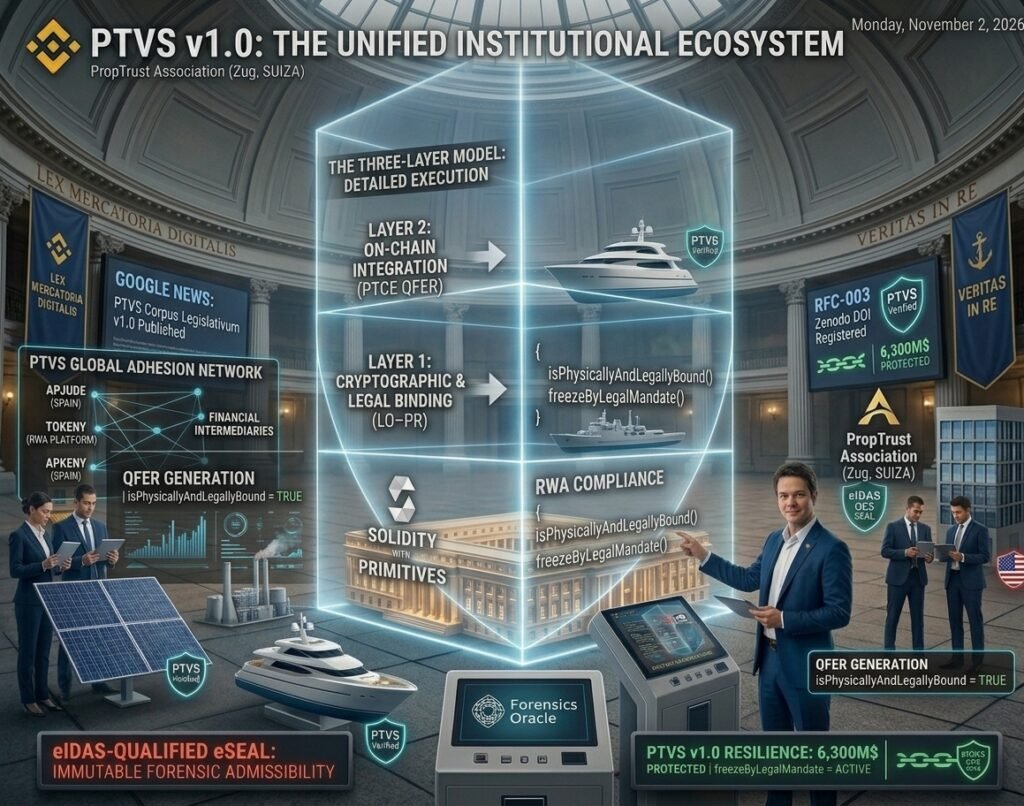
Zug, Switzerland — The evolution of the Qualified Forensic Evidence Record (QFER) from a static audit report to a dynamic, negotiable Digital Credit Instrument represents a paradigm shift in international trade finance. Under the Corpus Legislativum PTVS v1.0, the QFER is architected to function as a document of title, enabling the seamless financialization and transfer of Real-World Asset (RWA) collateral across global borders.
This transformation is legally grounded in the UNCITRAL Model Law on Electronic Transferable Records (MLETR, 2017) and the historical frameworks of the Geneva Convention providing a Uniform Law for Bills of Exchange and Promissory Notes (1930).
I. MLETR (2017) and the Functional Equivalence of QFER
The UNCITRAL MLETR (2017) establishes the principle of “functional equivalence” between paper transferable documents (like bills of lading or promissory notes) and electronic records. For an electronic record to be considered a transferable document, it must satisfy three strict criteria. PTVS v1.0 is explicitly designed to meet and exceed these requirements:
1. Reliability of Integrity (Art. 10)
The QFER utilizes SHA-256 hashing anchored to the EBSI Trusted Register. Any alteration to the forensic data instantly invalidates the hash, providing mathematical proof of integrity superior to paper.
2. Capability of Control (Art. 11)
Through W3C Decentralized Identifiers (DIDs) and eIDAS 2.0 Qualified Electronic Signatures (QES), the QFER ensures that only the authorized holder can exercise control, transfer, or endorse the record.
3. Uniqueness (Art. 12)
The PTVS protocol ensures that only one authoritative version of the QFER exists on the EBSI ledger at any given time, preventing double-spending or conflicting claims of ownership.
II. The Geneva Convention (1930) and Digital Endorsement
The Geneva Convention providing a Uniform Law for Bills of Exchange (1930) governs the transfer of negotiable instruments through endorsement. Historically, this required a physical signature on the back of the document.
Under the Corpus Legislativum PTVS v1.0, the transfer of a QFER-backed RWA token is executed via cryptographic endorsement. When a PTCE or asset holder transfers the QFER, they sign the transaction hash using their eIDAS 2.0 QES private key. This digital signature is legally recognized as a valid endorsement under the functional equivalence principles of MLETR, satisfying the Geneva Convention’s requirements for the transfer of rights in jurisdictions that have adopted the UNCITRAL framework.
III. UCP 600 and the Digitization of Documentary Credits
The Uniform Customs and Practice for Documentary Credits (UCP 600), published by the International Chamber of Commerce (ICC), governs Letters of Credit (LCs). Article 20 of UCP 600 requires the presentation of original documents.
The QFER, by virtue of its MLETR compliance and eIDAS 2.0 QES signature, qualifies as an “original” electronic document. Furthermore, the ICC eUCP (Electronic Supplementary Rules) explicitly allows for the presentation of electronic records. By integrating the QFER into the smart contract layer (ERC-3643), PTVS v1.0 enables the automated presentation and verification of documents for trade finance LCs, reducing settlement times from days to minutes.
“We are not merely digitizing paper; we are upgrading the fundamental plumbing of global trade finance. By aligning the QFER with MLETR and the Geneva Convention, we transform forensic truth into liquid, negotiable capital that can flow across borders with the speed of code and the legal certainty of a Swiss bank vault.
ATAurelio Tamarit BlayLead Architect, PTVS v1.0 · Official Judicial Expert Col. No. 0161Managing Member, Aurema Group LLC (Delaware)
IV. Smart Contracts as Automated Clearing Houses
The ultimate realization of the QFER as a credit instrument is its integration with the RFC-003 ‘Hollow Token’ protocol. When a QFER is presented to a smart contract governing an RWA token, the contract automatically verifies:
- Authenticity: Is the QFER signed by an active, accredited PTCE (verified via EBSI DIDs)?
- Integrity: Does the SHA-256 hash match the EBSI Trusted Register anchor?
- Control: Is the presenter the rightful holder of the QFER’s private keys?
Upon successful verification, the smart contract executes the transfer of the RWA token or releases the Letter of Credit funds automatically, acting as a decentralized, trustless clearing house governed by the Corpus Legislativum.