
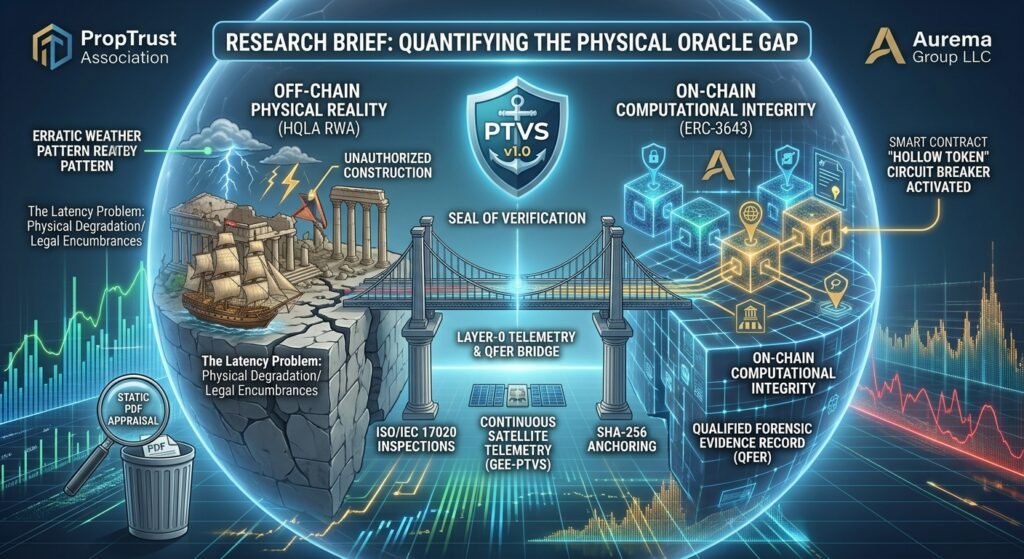
01. The $30 Trillion Blind Spot
A recent internal analysis by the PropTrust Association highlights that while blockchain technology guarantees on-chain computational integrity, smart contracts remain fundamentally blind to off-chain physical reality.
For High-Quality Liquid Assets (HQLA) governed under European Union MiCA (Arts. 36/46) regulations and Basel III (SCO60) capital adequacy frameworks, relying on static, annual PDF appraisal reports or purely financial data feeds constitutes a fundamental failure of continuous due diligence.
02. Key Findings & Telemetry Architecture
The Latency Problem
Traditional forensic reports cannot detect real-time physical structural degradation, unauthorized construction work, or sudden legal encumbrances (e.g., cross-border maritime liens or municipal tax freezes) placed on a tokenized asset. The token continues to trade on-chain as if fully collateralized, creating toxic asset exposure.
The Cryptographic Solution (QFER)
The Prop Trust Verified Standard (PTVS) v1.0 resolves this gap by mandating that all physical inspections generate a Qualified Forensic Evidence Record (QFER). QFER hashes (SHA-256) are anchored via eIDAS 2.0 Qualified Electronic Signatures (QES) onto the European Blockchain Services Infrastructure (EBSI), bridging court-admissible evidence directly into smart contract memory.
Layer-0 Telemetry & GEE-PTVS Satellite Integration
By integrating continuous satellite telemetry (via GEE-PTVS – Google Earth Engine PTVS pipeline) alongside ISO/IEC 17020-compliant human judicial peritaje, the framework creates a deterministic, cryptographically anchored truth layer.
This Layer-0 telemetry feeds directly into ERC-3643 smart contract permission registers, capable of triggering the RFC-003 ‘Hollow Token’ circuit breaker to automatically freeze token transfers if physical damage or legal risk is detected.
Structural Comparison: Traditional vs. PTVS Layer-0
| Verification Vector | Legacy RWA Tokenization | PTVS v1.0 Framework |
|---|---|---|
| Inspection Frequency | Annual Static PDF | Continuous Telemetry + QFER |
| Legal Admissibility | Jurisdictional Ambiguity | eIDAS 2.0 QES / EU Court Valid |
| Smart Contract Reactivity | None (Blind Contracts) | RFC-003 ‘Hollow Token’ Circuit Breaker |
| Satellite Verification | Not Integrated | GEE-PTVS Multispectral Pipelines |
03. Institutional & Regulatory Impact
This research underscores why regulatory bodies (including Spain’s CNMV and the European Banking Authority – EBA) are increasingly demanding Layer-0 forensic verification as an obligatory prerequisite for institutional RWA issuance.
Furthermore, the alignment of PTVS with W3C Verifiable Credentials (VC) schemas ensures that certified judicial experts (PTCE) can issue cryptographically signed physical audit credentials that interact seamlessly with European institutional Web3 infrastructure.
““Blockchain guarantees that the ledger cannot be altered, but it cannot prevent a toxic or degraded asset from entering the ledger. Layer-0 forensic peritaje is the missing physical oracle.”
ATAurelio Tamarit BlayLead Architect, PTVS v1.0 · Official Judicial Expert Col. No. 0161Managing Member, Aurema Group LLC (Delaware)